Emilia has just earned a digital badge titled Financial Modelling. The credential looks impressive and technically sound. Her university appears as the issuer, her name is attached as the recipient, the award date is recorded, and the badge can be shared, traced and verified across digital systems.
James, a graduate recruitment manager, opens the credential while reviewing Emilia’s application. The record gives him useful assurance about provenance: the university genuinely issued this badge to this student. What remains unclear is the educational judgement behind the award. Emilia may have attended a workshop, completed an online module, passed a knowledge test, built a guided spreadsheet or independently constructed a financial model through an assessed task. Each route could lead to a legitimate credential, yet each would support a different conclusion about what Emilia can actually do.
Attended a workshop
Participation
Completed an online module
Completion
Passed a knowledge test
Understanding of the principles
Built a model in an assessed task
Observed performance under stated conditions
Dr Hassan, the academic responsible for the badge, knows which task Emilia completed, how demanding it was, which criteria were used and what evidence informed the award. James sees only the information that survived into the credential. The quality of the signal therefore depends on how much of that underlying judgement the credential preserves and how clearly the resulting capability claim is bounded.
Credentials make educational judgement portable
Credentials compress complex educational experiences into forms that can travel. A degree condenses years of study, assessment and institutional judgement into one recognised award. A certificate can represent completion of a course or professional requirement. A digital badge can make a smaller achievement visible across platforms and contexts.
That compression serves a real purpose. James cannot reconstruct Emilia’s full educational history for every recruitment decision. Emilia needs practical ways to carry achievements earned through courses, projects, workplaces and professional learning. Dr Hassan needs a credible mechanism for recognising that a defined threshold has been crossed.
The challenge is informational. Compression inevitably removes detail, and the value of the credential depends on which detail disappears. A degree may confirm completion of a substantial programme while revealing little about the distinctive capabilities demonstrated by one graduate. A certificate may represent participation, knowledge, practical performance or professional competence. A badge may recognise contribution, completion, assessment or mastery. The format tells James that an award exists; the educational meaning still has to be carried through the information attached to it.
Research on representations of student achievement has made this limitation increasingly visible. Traditional degrees and transcripts remain influential, yet outsiders often receive limited information about the specific capabilities demonstrated by individual learners (Boud and Jorre de St Jorre, 2021; Ajjawi and Boud, 2024). Spence’s theory of job-market signalling helps explain why credentials remain valuable despite this compression. Employers make decisions under uncertainty, and educational credentials provide signals from which they infer qualities that cannot be inspected fully during recruitment (Spence, 1973).
A credential therefore transports institutional judgement into another setting. Its usefulness depends on whether the receiver can understand the judgement well enough to use it.
Digital credentials improved the record, while leaving judgement to the issuer
Digital credential standards have strengthened the amount of information that can travel with an award.
Open Badges 3.0 can carry information about the issuer, recipient, achievement, criteria, alignment and evidence, while also supporting verifiable credentials that improve integrity, ownership and portability across systems (1EdTech Consortium, 2024).
Policy frameworks have moved in the same direction. The European Union’s approach to micro-credentials recommends information on learning outcomes, workload, level, assessment and quality assurance (Council of the European Union, 2022). Australia’s National Microcredentials Framework requires assessment of stated learning outcomes and excludes participation-only badges from its formal definition of a microcredential (Australian Government Department of Education, Skills and Employment, 2022).
These developments give Emilia’s badge the potential to communicate substantially more than a conventional course title and grade. Criteria can be inspected, evidence can be linked, context can be retained and provenance can be verified. Smaller achievements become visible in ways that traditional transcripts often struggle to represent.
The additional fields do not determine the quality of the judgement placed inside them. An evidence field can point to substantial assessed work or to a decorative artefact with little diagnostic value. A published rubric can distinguish demanding standards or merely repeat broad language. Alignment with a recognised framework can improve consistency while leaving the learning experience and assessment design weak. Verification confirms that Dr Hassan’s university issued the badge, while the credibility of the capability claim still depends on what the institution observed and how carefully it interpreted the evidence.
Digital infrastructure can therefore strengthen the record without resolving the educational questions that produced it. Those questions remain part of credential design rather than credential technology.
What James needs to know before the badge becomes useful
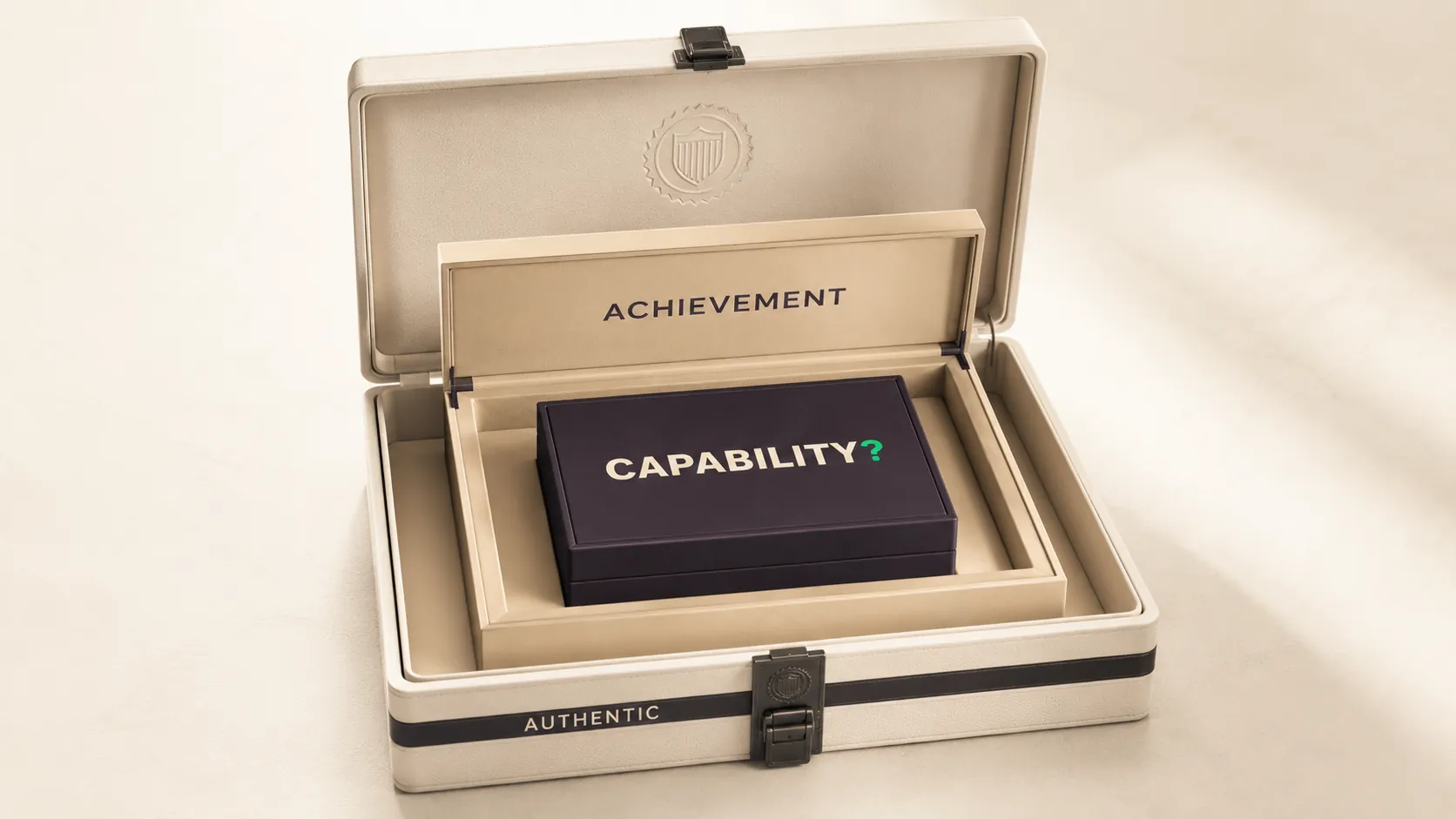
For James, the credential has to answer several layers of interpretation.
Is the credential authentic?
What achievement was recognised?
What capability can the achievement support?
Is the credential authentic?
He first needs confidence that the record is genuine, belongs to Emilia and has not been altered.
Open Badges 3.0 strengthens this layer through verifiable credentials and cryptographic proof, allowing the provenance of the award to be inspected with greater confidence.
What achievement was recognised?
He then needs to understand which achievement Dr Hassan recognised.
Attendance, course completion, a passing score, successful performance on a practical task and professional competence represent very different thresholds. The title Financial Modelling gives James a topic but leaves the achievement ambiguous.
Emilia may have learned modelling concepts, completed guided templates or independently built a coherent model from unfamiliar financial information. The credential becomes easier to interpret when it states which of these thresholds was actually crossed.
What capability can the achievement support?
The most consequential judgement concerns the capability that the achievement can support. That conclusion depends on what the assessment made observable, how the criteria distinguished stronger from weaker performance and how closely the evidence matches the claim being communicated. Context, difficulty, autonomy and expected standard all influence the distance between observed performance and the broader inference attached to it.
Assessment research places validity in the interpretation and use supported by evidence rather than in the existence of a score or judgement alone (Kane, 2013). The same logic applies to credentials. A correctly issued badge can accurately record that an academic decision was made. The broader claim about Emilia’s capability becomes credible only when the evidence justifies the interpretation attached to that decision.
Suppose Emilia completed an assessed financial-modelling task using a clean set of assumptions and historical statements. That performance could support a substantial claim about her ability to structure a model, connect financial statements, construct forecasts, test assumptions and produce a defensible output under those conditions. The evidence would give James a meaningful view of demonstrated capability while still leaving uncertainty about how Emilia would perform with incomplete data, conflicting assumptions, unfamiliar business models or senior stakeholders challenging the logic of the forecast.
- 1
What the task can support under clean assumptions
Structure a modelLink statementsBuild forecastsTest assumptionsProduce a defensible output - 2
What it leaves less certain
Incomplete dataConflicting assumptionsUnfamiliar business modelsSenior stakeholders challenging the logic
A knowledge test establishes a different boundary. Strong performance may show that Emilia understands principles of financial modelling, yet it provides limited evidence about her ability to build a reliable model for a consequential business decision. Credential credibility improves when the claim reflects the actual reach of the evidence instead of using the badge title to imply a broader capability than the assessment observed.
Employer trust depends on interpretable evidence
Employer interest in micro-credentials varies across providers, fields and programme designs, and the evidence base on labour-market value continues to develop (OECD, 2023). The available research still points towards a recurring requirement: employers need enough information about relevance, rigour and context to understand what the award represents.
Miller and Jorre de St Jorre (2024), interviewing environmental professionals in Australia, found broad support for a proposed micro-credential alongside requests for clearer context and stronger confidence in the standards behind it. The credential became more useful when employers could understand the conditions under which the achievement had been earned and the judgement that supported it.
Maina et al. (2022) provide a concrete example of richer credential design. Their pilot across three East African universities connected badges with rubrics, assessed evidence, contextual explanation and competency-based ePortfolios. Students selected evidence, explained what it demonstrated and submitted their claims for academic judgement before employers reviewed the resulting profiles.
The study was bounded and does not establish broad labour-market impact, but its design illustrates how a badge can become easier to interpret when the receiver can move from the visible credential to the work, context, criteria and judgement behind it. The visual symbol then acts as an access point to evidence rather than as a substitute for evidence.
For James, this distinction determines whether the badge reduces uncertainty or merely adds another graphic to Emilia’s profile. A credible credential gives him enough information to understand what was demonstrated and decide whether that evidence is relevant to the role in front of him.
Credential quality inherits the decisions made earlier
Credential projects are often discussed at the point where titles, visual identity, issuer information and platform configuration become visible. The more consequential design decisions occur earlier, because every weakness in capability definition, learning design or assessment eventually travels into the credential.
A vague capability produces an ambiguous claim. An educational experience that offers little meaningful practice generates limited evidence of performance. An assessment focused on recall cannot support a broad claim about practical capability. Digital portability can distribute thin evidence efficiently, but distribution does not strengthen the evidence itself.
Dr Hassan therefore needs to define the capability before finalising the badge. The recognised achievement should be explicit, the assessment should place the relevant capability under meaningful demand, and the evidence should support the level of inference attached to the award. Criteria, context and expected standard help the receiver understand what Emilia had to demonstrate, while provenance establishes who made the judgement and under which institutional conditions.
The boundary of the claim matters just as much as the claim itself. A knowledge assessment can support a conclusion about understanding. A practical demonstration can support a conclusion about observed performance under defined conditions. Claims about capability across industries, modelling approaches and decision environments require evidence broad enough to justify that wider interpretation.
This precision protects Emilia because it allows a genuine achievement to travel without inflation. It also protects James from interpreting an attractive title as evidence of a capability that the assessment never established.
The Unified Skills Map gives the credential a clearer starting point
HELFFE created the Unified Skills Map to clarify the nature of human capability before development, assessment, evidence and recognition are attached to it. Within the framework, Practical Skills describe what a person can do in concrete situations. Knowledge Domains organise what a person understands and uses to interpret those situations. Generative Skills capture the analytical, creative and emotional capacities that support learning, development and adaptation.
That structure helps Dr Hassan determine what kind of claim the badge is intended to carry. A credential based principally on a knowledge assessment can identify the relevant Knowledge Domain and avoid implying demonstrated practical performance. A badge earned through an assessed financial-modelling task can specify the Specific and Technological Practical Skills made observable through the work. Evidence of analytical judgement or adaptation can be linked to the relevant Generative Skills when the performance genuinely required those capacities.
The framework does not perform the assessment, validate the evidence or provide the digital credential infrastructure. Its role is earlier and more conceptual: it gives the institution a disciplined capability language before the credential compresses that capability into a portable signal.
That starting point improves the whole chain. Dr Hassan can define the award with greater precision, Emilia can explain what she achieved without relying on an inflated title, and James can interpret the credential without reconstructing its meaning from guesswork.
A strong credential preserves enough of the chain to support trust
Credentials remain valuable because educational and professional achievements need forms of recognition that can travel. Degrees, certificates, badges and portfolios can all carry useful signals when the relationship between the recognised achievement, the evidence and the capability remains intelligible to the receiver.
A strong credential therefore exposes enough of its working for another person to understand what happened, what was judged, which evidence supported the decision and where the claim should stop. The receiver should not need to inspect every artefact Emilia produced, but the credential should preserve enough context and evidence for James to decide whether the claim is relevant, credible and sufficient for the decision he is making.
Digital verification strengthens trust in the record itself. Educational credibility comes from the quality of the capability definition, assessment and evidence embedded in that record. The badge becomes valuable when those layers remain visible enough for the next person to interpret the achievement without guessing what the title was meant to prove.